Enhancing Student Engagement in Online Learning

Beyond the Screen: My Experience with Student Engagement in Online Learning
Introduction
As a master’s student in education, I have always been deeply interested in how online learning environments shape student success. Throughout my academic journey, one question has continued to drive my research: How can we make online learning more engaging, interactive, and meaningful for students?
The shift toward online learning has opened enormous doors to access and convenience, but it has also posed an enormous challenge—student engagement. Unlike traditional classrooms, online learning does not have the same face-to-face immediacy of human connection, so students can more readily feel alone, drowning, or disconnected. During my graduate work, I have learned theories, research, and real-world applications that can transform distance learning into an active and student-centered experience. This project is my way of bridging that engagement gap.
My Motivation and Personal Journey
My passion for student engagement began during my graduate studies. During my time as a Teaching Assistant (TA) at the University of Victoria (UVic) during the COVID-19 pandemic, I experienced firsthand the problems of online learning. Students switched from cameras, were frequently muted during lectures, and were disengaged from engaging with the classroom discussions. This disengagement amplified an issue question: were they really learning, or merely passing through the exercise of appearing for class? I began to receive emails from students asking about content that had already been discussed—sometimes even just prior to an assignment or a test—suggesting that they were struggling with connecting the material.
Having had the opportunity to work as a teaching assistant, time and again, my own personal education experience keeps coming back to me. I could have had some of my most exciting learning experiences from professors who kept me, and my classmates actively engaged through lively activities and discussions, group works and practical applications of the concepts taught in class. These creative and interactive teaching methods have taught me that learning could really be fun, and effective learning does not necessarily need the old-fashioned way of lecturing. On the other hand, I also observed the injustice of disengaged teaching—where inflexible teaching approaches and favoritism crushed curiosity and motivation. Thus, I have come to realize that every student is entitled to an experiential learning involvement active, engaging, inclusive, stimulating curiosity, and deep understanding.
This project stems from my passion to ensure that every student, have access to engaging and interactive education. By leveraging technology and research-tested engagement strategies, I want to provide educators with practical tools that maximize the interactive potential of online learning, making it more effective and student-centered.

The Purpose of This Project
This website is the combination of my research and passion for educational innovation. It is intended as a resource for educators interested in applying effective engagement strategies to online learning. Whether you are an instructor seeking new methods for encouraging participation or an educational leader working to improve student retention, this site provides insights, tools, and interactive features that will enable you to make learning more engaging and effective.
What You’ll Find Here
An Engagement Guide
This step-by-step guide/tutorial offers practical and research-based techniques to increase student engagement in online learning.
Interactive Learning Tools and Feedback Templates
This section integrates drag-and-drop exercises and discussion-based activities that show how interactive activities can enhance engagement. Also, easy-to-use feedback ideas that help students feel seen, supported, and encouraged to stay engaged.
WordPress & Tech Implementation Guide
Learn how to incorporate engagement strategies into your own online courses, including how to structure content, use multimedia tools, and integrate H5P interactive elements.
Why This Matters
Student engagement isn’t just about making learning fun—about making school an enjoyable experience—it’s about designing a purposeful, engaging, and nurturing learning environment that encourages curiosity, critical thinking, and long-term academic achievement. My goal with this project is to help teachers in reimagining how they think about online learning and give them the tools to revolutionize online classrooms as spaces for student success. Through my research, I have learned that engagement is not a one-size-fits-all concept. While some students excel with discussion-style activities, others do better with problem-solving, hands-on activities. Teachers need to have a wide range of strategies at their disposal that enable them to meet various learning styles and needs. By incorporating cutting-edge pedagogical methods, teachers can build online classrooms that reflect the same levels of engagement as traditional face-to-face classrooms.
Join Me in Reimagining Online Learning
I invite you to explore this website, experiment with the interactive tools, and apply these strategies in your own classroom. If you are a teacher, a researcher, or a student looking for better ways to stay engaged in online learning, I invite you to discover something here that will be useful and enlightening to you. Together, let’s work to make online education a more active and satisfying experience for all learners. Let’s innovate, experiment, and redefine engagement in online learning—one interactive lesson at a time!
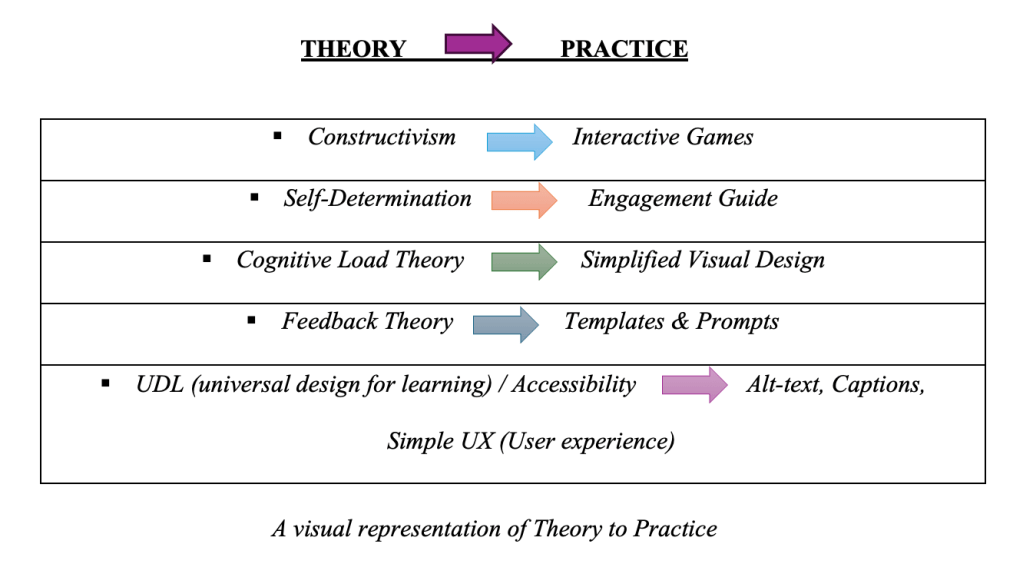
Implementing Engagement Strategies in Your Courses
Use Two Modes of Engagement
Select two evidence-based strategies for engagement that will meet your course objectives and your students’ needs. Examples include any of the active learning approaches such as discussion-based learning, games, collaborative projects, real-life case studies, etc. Put them into your next online class. Then, watch how they engage with the material and each other.
Using a New Digital Tool
Explore a online tool such as an interactive polling application, virtual whiteboards, AI-enabled discussion platforms, video or audio recordings, or multimedia content creation for increasing student engagement. Apply this tool to an online class and study the impact it has on students’ engagement, understanding, and motivation.
Modify and Perfect Strategies
Engagement is, therefore, an ongoing iterative refinement process. It’s important to analyze what is working as discerned from data and student feedback and what may be improved. Carry out changes in one’s approach according to such findings and try different methods and technology to get improved engagement in future classes.
Monitor the Parameters of Engagements
Both qualitative and quantitative data should be used to assess engagement in students through the session. Use learning analytics from your learning management system (LMS) to measure participation rates, time spent by students on activities, and the completion of interactive tasks. Further qualitative input may be gathered via surveys, as well as analysis of students’ contributions in discussions.
Conclusion
- Student engagement in online learning is a evolving and multi-dimensional process requiring engaging instructional design, good pedagogical practice, and leveraging technology to foster meaningful learning experiences. The research is full of the strong correlation between student engagement and academic success, making it an indispensable component of online learning (Kuh, 2006). However, engagement is not an end product but a dynamic, adaptive process liable to constant diagnosis and revision (Trowler, 2010).
- An effective engagement plan has to be multidimensional in addressing behavioral, emotional, and cognitive dimensions. Behavioral engagement ensures students remain actively participant in their own learning. Emotional engagement generates the sense of belonging, motivation, and resilience that allows students to persist with courses. Cognitive engagement, however, promotes critical thinking and deep learning that equips students with life skills outside of the classroom (Fredricks et al., 2004). When all three aspects are addressed simultaneously, students tend to remain motivated, engaged, and academically successful (Reschly & Christenson, 2022).
- The future of online learning depends on a research-driven, student-focused philosophy that puts engagement at the forefront of learning success. By embracing evidence-based practices, establishing significant student engagements, and integrating web-based tools, teachers have the potential to bridge the engagement gap and create more engaging, interactive, and effective online learning environments.

- Thus, involvement of students in online teaching is essential to achieving academic success and retaining knowledge. Through the implementation of research-based practices, technology integration, and interactive community design, teachers can make online learning an interactive, student-centered process. Engagement must not be thought of as an isolated intervention but as a constant process that aligns pedagogy, technology, and students’ needs (Kuh, 2006).
Project

Ann Paulose
 eduengagehub.com